Keto and Tilikum Express the Stress of Orca Captivity
In a new study, nearly a year in the making, former SeaWorld trainers Jeffrey Ventre, MD and John Jett, Ph.D, take us deep behind the scenes of Marine parks and their ability to provide environments adequate for keeping killer whales alive in captivity.
Drs Ventre and Jett introduce us to detailed observations and strong statistical calculations that add up to an abundance of evidence that captivity kills orcas, usually at a young age… and that stresses, social tensions and poor health are chronic issues in marine park facilities.
Born from this report, a new statistic called “Mean Duration of Captivity” (MDC), drawn from diverse credible sources, allows overall comparisons with free-ranging orcas and reveals a shockingly low average longevity in captivity.
In this research paper, which can also be viewed and downloaded in its’ entirety HERE or en español, you’ll see the precursors and symptoms of stresses in orcas in captivity, illustrated with powerful photos. The authors invite students, teachers and the public to share these images and use them in their reports and projects.
As former orca trainers, and now a medical doctor and biology professor respectively, Drs Ventre and Jett have a perspective that has not been heard in the intensifying debate about captivity for orcas:
Manuscript submitted to The Orca Project by:
John S. Jett
Visiting Research Professor
Stetson University
jjett@stetson.edu
&
Jeffrey M. Ventre
Physician
New Orleans, LA, USA
jmventre@gmail.com
Appendix A Compiled by John Kielty
Appendix B Adapted by the Authors
The practice of keeping killer whales in captivity has proven to be detrimental to the health and safety of animals and trainers alike. On Christmas Eve, 2009, trainer Alexis Martinez was killed by a male captive bred orca named Keto, who was on loan from Sea World to a facility called Loro Parque, in the Canary Islands, Spain. Two months later, on 24 February 2010, trainer Dawn Brancheau was killed by Tilikum, an animal involved with two previous human fatalities. Medical Examiner (ME) reports described massive trauma to both Dawn and Alexis. Neither death was accidental.

Dawn Brancheau and Alexis Martinez at Loro Parque, Spain. Both trainers were killed by SeaWorld orcas two months apart. The pictures and graphics in this report can be opened and expanded by “clicking” on the photo and then “right-click” to download/save to your computer.
While orca captivity generates large profits for companies like Sea World (SW), life in a shallow concrete tank is greatly impoverished compared to the lives of their free-ranging counterparts. Trainer deaths, whale deaths, and numerous documented injuries to both trainers and whales provide evidence of several key issues related to killer whale captivity.
Tilikum is representative of the many social and health issues plaguing captive orcas. Typically spending their entire lives within tight family groupings, orcas captured from the wild, including Tilikum, have been traumatically extracted from the security, comfort and mentoring which these groupings provide. Captured animals are confined to small, acoustically-dead, concrete enclosures where they must live in extremely close proximity to other whales with which they often share no ancestral, cultural or communication similarities. The resultant infighting amongst captive orcas is exacerbated by virtue of having no place to run, as confinement fails to provide spatial escape options that natural settings offer. As a result, social strife is common in captivity, including aggression, in which whales are cut, raked, and rammed, usually by members higher on the social ladder. In one particularly brutal example, Kandu V, a female orca at Sea World of California (SWC), bled to death after 11.9 years (4332 days) in captivity when an artery was severed at the upper jaw (See Appendix A). The wound was self-inflicted as she collided with another whale in a display of dominance. Over the next 45 minutes, and in view of the public, she slowly bled out, spouting blood from her blowhole until she died.

Kandu V Spouts Blood from from her blowhole on the day of her death
If left alone, the decaying pulp forms a cavity that leads to food plugging. The reaction of the orca’s immune system to this plugging is to create inflammation and eventually a focus for systemic infection. Because of the relative youth of most captive whales, the roots of many of their teeth are immature, which makes a root canal procedure impossible. Instead, using a variable speed drill, trainers drill holes through the pulp and into the jaw via an endodontic procedure called a modified “pulpotomy.” This is an uncomfortable husbandry procedure for the whales, which have been observed refusing to participate by sinking down into the water, shuddering, or splitting from their keepers. After “tooth drilling” is complete, trainers must irrigate (flush) the bored out teeth two-three times each day, for the rest of the orca’s life, to prevent abscess, bacteremia, and sepsis. (Kalina’s reported cause of death, “acute bacterial septicemia,” should make one ponder how bacteria entered her bloodstream. See Appendix A). Consequently, orcas at SW and other facilities, like Six Flags, often possess a significantly reduced number of viable teeth, making them poor candidates for release into the wild.
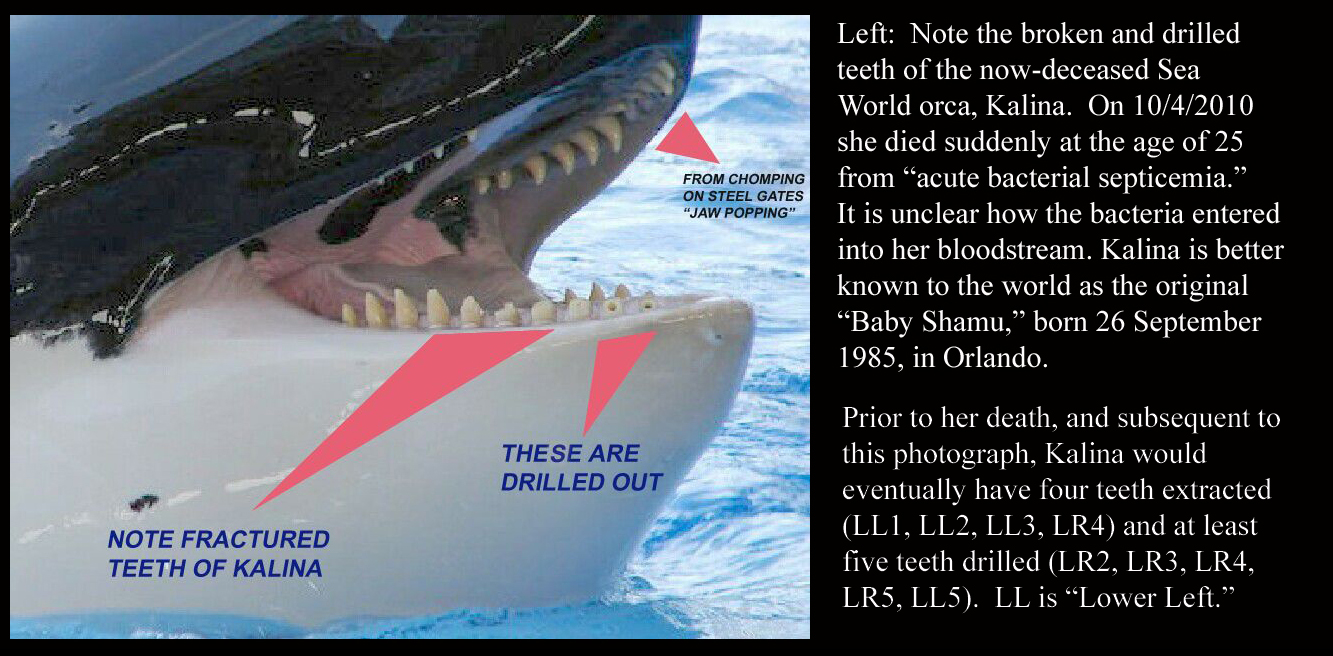
“The Original Baby Shamu” Kalina’s broken and drilled teeth
In the medical field it is known that poor dentition can lead to a host of diseases including valvular heart disease, gingivitis, pneumonia, stroke, and heart attack. These open bore holes represent a direct route for pathogens to enter the blood stream where they can then be deposited into the tissue of various organs throughout the body, such as the heart or kidney. Unfortunately, orca necropsies are mostly done in-house, by park personnel, and under a relative cloak of secrecy. So despite the prevalence of poor teeth, it is not known what role they play in captive orca deaths. For example, many whales reportedly die of pneumonia. Could the cause of pneumonia be bacteria carried to the lungs from rotting food plugs or tooth decay? This is unclear due to insufficient research and lack of scrutiny. Along these lines, pathology reports, and other relevant documentation of the lives and deaths of captive orcas are poorly archived at the National Marine Fisheries Service (NMFS), a division of the National Oceanic and Atmospheric Administration (NOAA), the federal agency tasked with tracking captive marine mammal data. Unfortunately, as a means of obfuscating relevant data, marine parks such as SW typically avoid attaching animal names with the cetacean records kept by the aforementioned agencies. Instead, by utilizing code numbers, marine industry claims are difficult to fully investigate.
[NOTE: Please see the attached Appendix A for captive orca birth, capture, and death data. This compiled spreadsheet reconstitutes missing and/or coded information contained in the NMFS’s Marine Mammal Inventory Report (MMIR), and introduces a new statistic, “Mean Duration of Captivity,” (MDC) measured in days for ease of comparison and computation.]

Orkid and Sumar undergo Teeth Flushing in what is known as “Superior Dental Care” by Seaworld Public Relations
Veterinary and animal care workers at marine parks are under considerable pressure to keep valuable captive assets, such as orcas, alive. As such, it is common practice to administer on-going prophylactic medications such as those that reduce stomach acid production and block histamine, like Tagamet. Stress-related ulcers are common in captive marine mammals and must be dealt with medically. Similarly, the use of antibiotics is often the immediate response to an animal appearing “off” or “slow,” and at any given time one or more orcas may be receiving antibiotics.

Click on Thumbnail to see Tilikum’s Medical Review by APHIS (PDF)

Deceased orca Kanduke’s progressive dorsal bending is measured and compared to a wild orca (T20)
Less understood are the consequences from increased ultraviolet (UV) radiation exposure to the skin, eyes, and immune systems as animals float motionless at the surface. Orcas in marine parks sometimes suffer from sunburn, and trainers or animal care staff will apply sun-block and black (colored) zinc oxide to the backs of those animals which show signs of burn, or who otherwise spend inordinate amounts of time surface resting. Furthermore, at least one serious trainer injury has been linked to a whale’s poor visual acuity, possibly secondary to cataract formation. It is known that UV radiation exposure is a factor in the development of cataracts, especially in low latitude environments with elevated sun exposure. Compounding the issue, water in orca tanks is shallow and clear, offering no natural protection from the sun’s harmful rays. Contrastingly, free-ranging orcas spend most of their time at higher latitudes, in darker water, and at greater depths, and none spend time looking up at humans with their heads “on deck.”
In the medical community it is also accepted that UV radiation can act as an immunosuppressant and can cause retinal damage, among other physiological risks. Unfortunately, little is known of the long-term effects on captive orcas exposed to the sun to such an unnatural extent. The USDA-APHIS, which is charged with enforcement of Animal Welfare Act (AWA) provisions such as protection from the weather and direct sunlight, has historically been ineffective in ensuring compliance with the numerous regulations designed to provide minimum standards of care for captive marine mammals.

Tilikum’s enormous size is reflected in this photo. Only 2 pools at Shamu Stadium are deeper than he is long.
Orcas are carnivores, not scavengers. In the wild they consume a diet of live (not dead) prey items depending on which cultural subset they come from. For example, New Zealand orcas are known to feed on sharks and rays, while Icelandic and Northwestern orcas eat herring and salmon. Still others feed on marine mammals such as sea lions, porpoise, and baleen whales. Although from diverse places of origin, orcas in captive environments are forced to eat a non-varied diet of carrion. At Sea World this consists of frozen-thawed whole fish, Clupea harengus (herring), Thaleichthys pacificus (smelt), and Oncorhynchus gorbuscha (pink salmon), at approximately 2-3% of their body weight each day. Although staff members at these parks are trained to repeat the script that the fish is of “restaurant quality,” they fail to mention that free-ranging orcas don’t typically eat smelt, which are the size of sardines, and which constitute nearly half of their captive diet. It is not known how refrigeration and freezing of these fish impact the nutritional quality, nor is it known what long-term health consequences arise from feeding captive orcas food inconsistent with their culture. Additionally, since captives receive essentially the same diet every day, they are more susceptible to vitamin deficiencies from a lack of prey variety.
Marine parks such as Sea World tout their ability to provide environments adequate to keep orcas alive. However, this claim is not supported by the evidence. Approximately 157 orcas have died in captivity, not including stillborns and miscarriages. Based upon the MMIR data, and represented in Appendix A, we have calculated the mean duration of captivity (MDC) to be less than nine years. This is regardless of whether an orca was extracted from the ocean, or born at a theme park.
Globally, marine parks have enjoyed 60 live births since 1977. However, 32 of those animals (53%) are already deceased (Dec.). SW alone has had 28 live births, with nine deceased (32%), as are ten of the mothers. In the wild, successful calf-rearing is facilitated by mentoring mid-wives, family, and stable matrilines. Based on revised estimates by Olesiuk, Ellis and Ford, (2005), and regarding “Northern Resident” orcas, the mean age at first birth has been estimated to be 14 – 15 years. For comparison, captive orcas often become pregnant much earlier. In regard to wild female reproductive lifespan, “single calves are subsequently born at five-year intervals (from the mid-teens) over a [span] lasting about 25 years.” Reproductive senescence (the equivalent of menopause) occurs around 40 years of age.

Extraction of Semen from a Male Orca for Artificial Insemination
Giving birth at a young age comes with risks, including immature mothers refusing, or not knowing how, to properly nurse their calves. This is happening currently with a captive orca named Kohana, who is famous as SW’s second AI calf. On loan from SW to Loro Parque, she has recently given birth at eight years of age, in October of 2010. Kohana is not nursing this young orca and it is not clear whether it will survive via bottle and tube feedings. At SWF, Taima was a notoriously poor mother as well. She died from a prolapsed uterus while giving birth to her fourth calf on 6 June 2010, at the age of 20. Keep in mind that killer whale gestation is approximately 18 months in duration, and to reiterate, wild Northern Resident calves are “born at five-year intervals.”
Fathered by a transient bull named Kanduke (Dec. 9/20/1990, SWF) and an Icelandic mother Gudrun (Dec. 2/25/1996, SWF), Taima was a true hybrid, unknown in nature, being genetically half-transient and half-resident (transient and resident refer to two culturally and genetically distinct types of orcas). Was she too young at eight years of age to have Sumar (Dec. 9/7/2010, SWC)? It is known that she became very aggressive with him, and for his own protection he was shipped out of Orlando prior to his first birthday. Taima was also eventually banned from performing with trainers in the water, as she was deemed aggressive and unpredictable. As an aside, contrary to the common practice at marine parks of moving young whales to other parks and away from family, wild orcas typically spend their entire lives with family members who, among other things, assist mothers with calf-rearing (see Appendix B for a summary of Kalina’s travel record to various parks).

Keto, Tilikum and Taku Display Dorsal Collapse
Additionally, the authors introduce a new statistic, the Mean Duration of Captivity (MDC), which allows for the evaluation of lifespan in captivity. MDC and lifespan are the same for captive born orcas. We acknowledge that the MDC is not equivalent to lifespan for captured animals. However, it is a valid approximation based upon the historical preference of whale collectors to extract the younger orcas of a given clan or pod.
For our population of 152 killer whales that have lived and died in captivity, the MDC equals 2413 days or 6.6 years. This is a surprisingly low number, especially when compared with free-ranging orca longevity. We also acknowledge that husbandry procedures and veterinary care may have improved with time, and that the MDC only addresses dead whales for which data exist (n=152).
To incorporate both dead (n=152) and living whales (n=41) we utilized the Kaplan-Meier (KM) method of examining captive orca survival. Employing the median as most representative of the central tendency of the dataset, this method allows “credit” to be given for those whales that are still living, and helps predict orca survival in captivity. According to the records, there are 41 whales currently living at marine parks, and six (Corky, Lolita, Ulises, Katina, Kasatka, Tilikum) that have been living in captivity for greater than 28 years. It is not known what attributes have contributed to their exceptionally long lives (by captive longevity standards). However, expanding the overall population from 152 to 193, to include all whales still alive in captivity (including these long-lived whales), only produces a median duration of captivity of 3108 days or 8.5 years. Using KM, we can be 95% sure that the true median duration of captivity lies between 998 and 3250 days (2.7 and 8.9 years, respectively).
Using “Baby Shamu’s” landmark birth as a point when successful captive birthing began, 26 September 1985, the MDC differs little between the pre-Kalina (2453 days = 6.7 years, n=105) and post-Kalina birth cohorts (2323 days = 6.4 years, n=47). Though the data suggests that the post-Kalina birth cohort whales are living shorter lives, the MDC between the two is not statistically significant.
The time has come to evolve beyond keeping killer whales confined in small, unnatural spaces, purely for entertainment purposes. As we’ve demonstrated, their life spans are decreased and their behaviors altered from the stressors associated with confinement.

Katina and her two offspring, Taku & Kalina. Before his death, Taku and his mother Katina produced an inbred calf, Nalani.
One solution, which has already been proposed, and we support, would be to phase out captive populations naturally, via attrition. In short, stop breeding the animals and let those already in captivity live out their lives. Animals such as Lolita at the Miami Seaquarium, whose mother and family group are still alive, and whose teeth are in relatively good shape, may be candidates for a transitional reintroduction to the wild. However, whales with broken and bored teeth, such as Tilikum, and many others, are likely poor candidates for release back to their natural habitat without ongoing human intervention.
Jeffrey Ventre, MD, is a medical physician specializing in physical medicine and rehabilitation in New Orleans. John Jett, Ph.D, is a visiting research professor focusing on waterway management issues at Stetson University.
Both Drs Jett and Ventre worked as trainers at Sea World of Florida for a combined total of 12 years. They worked with several orcas, including Tilikum, and with Dawn Brancheau. After SeaWorld, they began professional careers that allow for this unique perspective. The authors thank Wendy Cooke, John Kielty, Samantha Berg, Carol Ray, Kim Ventre, Howard Garrett, Colleen Gorman, Chica, and Tim Zimmermann for their contributions to this paper. And a special thanks to Ester Quintana-Rizzo, Ph.D. and Alina Castañeda for providing the Spanish translation.
Click HERE to view Appendix A – Click HERE to view Appendix B
Click HERE (or en español) to Open/View/Print the Complete Paper and Appendices (PDF)
For an extraordinary orca experience, please visit Orca Tracker, a geospatial interactive map connecting orca events and scholars from around the world.
Trackbacks
- The Plight of Orcas in Captivity, Final Thoughts - Because Turtles Eat Plastic Bags
- It's Time to Get Honest About Captivity - Whale & Dolphin Conservation Australia
- It's Time to Get Honest About Captivity - Whale & Dolphin Conservation USA
- We hunt, capture, and train your young for entertainment purposes – FILOÉTICO – Experimento Ético en Comunidad
- Ethical Discussion 1 – Career Aspiration | Anne-Marie Weiss
- 上海千花坊官网,上海千花坊论坛,上海千花网论坛,上海千花网-Powered by Grid-Magazine!
- LES CAGES : CE QUE LES ORQUES NOUS APPRENNENT SUR NOTRE PROPRE LIBERTÉ - Adventiste Magazine
- 11 Facts Everyone Should Know About Orca Captivity – WOWrly
- Captive Orcas Prove Sitting Is the New Smoking | Green Society
- Captive Orcas Prove Sitting Is The New Smoking | Natural Health Resource Center
- Captive Orcas Prove Sitting Is the New Smoking - Tech News
- Dart, The 12-Year Old Dolphin, Has Just Died At SeaWorld. The Latest In A String Of Deaths - Holidog Times
- SeaWorld vs Scientists | Speak Up For Blue
- Špatný stav zubů | Orcast
- ABA and the Thorny Problem of Control and Consent | Think Inclusive
- We hunt, capture, and train your young for entertainment purposes | FILOÉTICO




 The Orca Project
How could you all have firsthand knowledge of what was going on behind the scenes and ignored it until you lost your job?
Why can’t they put fillings in or implants or something like that? Or just pull the tooth?
The orcas are intelligent animals and should be left in the ocean with their families. It is sad they are being used for profit.